
- Travellers Choice
- Private Safaris
- Travellers Choice
- Private Safaris
- exclusive Safaris
- personalised excursions
The Great Wildebeest Migration is one of the world’s most spectacular natural events. Every year, more than a million wildebeest, together with hundreds of thousands of zebra and gazelles, move across the vast plains of Tanzania’s Serengeti and Kenya’s Masai Mara ecosystem in search of fresh grass and water.
This extraordinary journey is commonly known as the Great Migration, Wildebeest Migration, Serengeti Migration, or Masai Mara Migration.
But when exactly does the migration take place?
Where are the wildebeest each month?
When is the best time to see the famous Mara River crossings?
And is the Masai Mara or Serengeti better for experiencing the Great Migration?
The answer is more complicated than simply choosing one month on a calendar.
The Great Wildebeest Migration is a continuous, year-round cycle.
The herds do not follow fixed dates. Their movements are influenced by rainfall, fresh grazing, water availability and changing environmental conditions. This means that the exact location of the animals can vary from year to year.
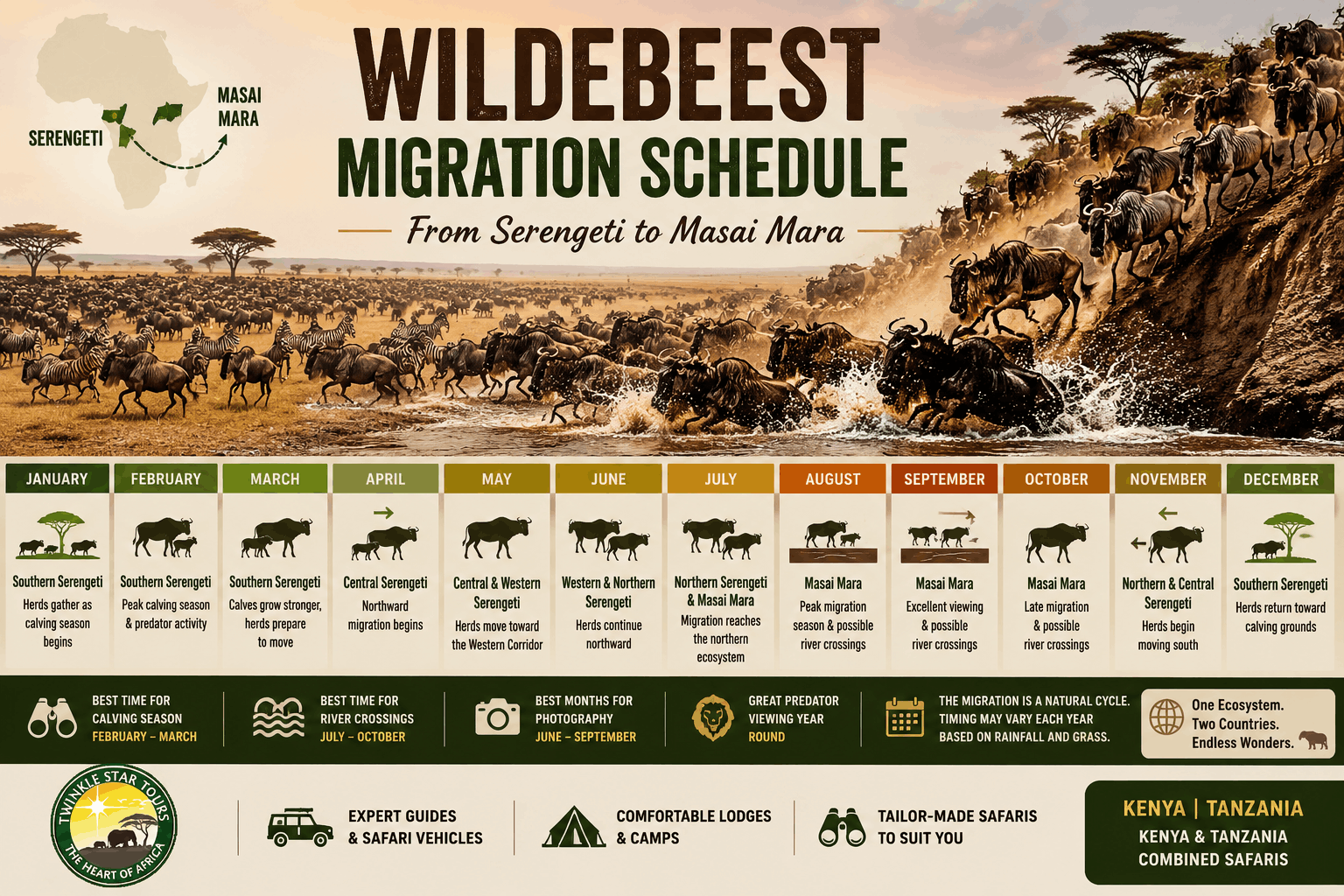
The schedule below provides a general month-by-month migration calendar based on the traditional movement of the herds through the Serengeti–Mara ecosystem. It is an essential guide for anyone planning a Great Migration safari in Kenya, Tanzania or Kenya & Tanzania combined, but it should be viewed as a seasonal guide rather than a guarantee of exactly where the herds will be on a particular day.
If you are planning a migration safari in 2027 or any future year, the broad annual cycle described in this guide can help you choose the most suitable travel period.
| Month | General Migration Location | What You Can Expect | Best Area to Visit |
|---|---|---|---|
| January | Southern Serengeti and Ndutu | Herds gather and calving season begins | Southern Serengeti |
| February | Southern Serengeti and Ndutu | Peak calving and predator activity | Southern Serengeti |
| March | Southern Serengeti | Calves grow and herds prepare to move | Southern Serengeti |
| April | Southern and Central Serengeti | Northward migration begins | Central Serengeti |
| May | Central and Western Serengeti | Large herds move toward the Western Corridor | Serengeti |
| June | Western and Northern Serengeti | Herds continue northward | Western/Northern Serengeti |
| July | Northern Serengeti and Masai Mara | Migration reaches the northern ecosystem | Northern Serengeti/Masai Mara |
| August | Masai Mara and Northern Serengeti | Peak migration season and possible river crossings | Masai Mara |
| September | Masai Mara and Northern Serengeti | Excellent migration viewing and possible crossings | Masai Mara/Northern Serengeti |
| October | Masai Mara and Northern Serengeti | Late migration and possible crossings | Masai Mara/Northern Serengeti |
| November | Northern and Central Serengeti | Herds begin moving south | Serengeti |
| December | Southern Serengeti | Herds return toward calving grounds | Southern Serengeti |
Important: This is a general migration calendar, not a fixed timetable. The timing of the migration can change depending on rainfall and pasture conditions. The famous Mara River crossings are particularly unpredictable and cannot be guaranteed on specific dates.
The migration generally follows a broad movement through the Serengeti–Mara ecosystem.
The cycle can be divided into several major phases:
1. Calving Season
The herds gather in the southern Serengeti and Ndutu area, where seasonal rains provide fresh grazing.
2. Northward Movement
The animals gradually move north through the central Serengeti as pasture conditions change.
3. Western Corridor
The herds continue toward the western and northern parts of the Serengeti.
4. Northern Serengeti and Masai Mara
The migration reaches the northern Serengeti and the Masai Mara ecosystem.
5. Mara River Crossings
Some herds cross the Mara River as they move between Tanzania and Kenya.
6. Return South
As rainfall returns to the southern Serengeti, the herds begin moving south again.
The cycle then begins again.
Because this is a natural process, the exact timing of each phase varies from year to year.
January is generally associated with the beginning of the calving season in the southern Serengeti and Ndutu region.
The arrival of seasonal rains encourages fresh green grass to grow across the plains.
This attracts huge numbers of wildebeest, zebra and gazelles.
The southern Serengeti becomes a spectacular wildlife destination, with large herds spread across open grasslands.
January is an excellent month for travellers who want to experience the migration before the busiest peak season.
If your priority is to experience the migration in its natural environment rather than specifically seeing river crossings, January can be an excellent time to visit Tanzania.
February is widely regarded as one of the most exciting periods of the migration cycle.
The southern Serengeti and Ndutu region can host enormous concentrations of wildebeest during the peak calving season.
Large numbers of calves are born during a relatively short period.
This creates one of nature’s most dramatic wildlife spectacles.
The abundance of newborn animals also attracts predators.
Lions, cheetahs, hyenas and other carnivores become highly active as they take advantage of vulnerable young prey.
For travellers interested in:
February can be one of the best months for a Serengeti Migration Safari.
It is generally more suitable for calving-season experiences than the Masai Mara, which is not normally the main location of the migrating herds at this time.
By March, the peak of the calving season begins to pass.
The young wildebeest are becoming stronger and more mobile.
The herds continue grazing in the southern Serengeti while gradually preparing for their next movement.
March can be an excellent month for travellers who want a combination of:
As pasture conditions change, the migration will eventually begin moving north.
April is generally a transitional period.
The herds begin moving away from the southern Serengeti and toward central areas.
Rainfall can make parts of Tanzania lush and green, creating beautiful photographic conditions.
The animals may be spread across a wide area, and the exact location of the largest concentrations can vary.
April is therefore an excellent month for travellers who want to experience the Serengeti during a quieter period.
The migration is moving, but it has not yet reached the famous northern river-crossing phase.
By May, the migration continues its northward journey.
Large herds can be seen moving across the central and western Serengeti.
The sight of thousands of wildebeest travelling in long lines across the plains can be spectacular.
The Western Corridor and Grumeti region become increasingly important as the animals continue north.
May can be particularly attractive to photographers because of the combination of:
Travellers visiting the Serengeti during this period can also enjoy sightings of resident wildlife that remains in the ecosystem throughout the year.
June is another important transitional month.
The herds generally continue moving through the western and northern Serengeti.
Some groups may be approaching the Mara River system, while others remain farther south.
This is when interest in the upcoming northern migration season begins to increase.
June can be a good option for travellers who want to experience the migration before the busiest peak season.
The herds are moving, the landscapes are dramatic and the Serengeti offers excellent year-round wildlife viewing.
July marks the beginning of the period most commonly associated with the Masai Mara Migration.
The herds gradually reach northern Tanzania and begin moving toward the Kenya–Tanzania border.
Some groups may enter the Masai Mara, while others remain in the northern Serengeti.
One of the most important things to understand about the migration is that it does not cross the border on a single day.
The herds are spread across a vast ecosystem.
Different groups move at different speeds.
Some may reach Kenya early, while others remain in Tanzania for weeks.
The first Mara River crossings may occur around this period, depending on rainfall and herd movement.
July is an exciting month for a combined Kenya and Tanzania safari.
August is one of the most popular months for experiencing the Great Migration.
Large concentrations of wildebeest may be spread across the northern Serengeti and Masai Mara ecosystem.
The Mara River becomes a major focus as herds attempt to move between grazing areas.
This is the period associated with some of the most iconic migration photographs.
Wildebeest may gather along riverbanks before attempting to cross.
When a crossing occurs, animals can plunge into the water in large numbers while crocodiles wait below.
The scene can be incredibly dramatic.
However, it is important to remember that river crossings are not scheduled events.
A herd may:
For this reason, August is an excellent month for a migration safari, but no operator can honestly guarantee that you will witness a crossing.
September is often considered one of the best months for experiencing the northern phase of the Great Migration.
Large herds may remain in the Masai Mara and northern Serengeti.
Mara River crossings may continue, depending on rainfall and herd behaviour.
September can offer an excellent combination of:
For travellers who want the possibility of witnessing a Mara River crossing while avoiding some of the busiest August travel periods, September can be an excellent choice.
As always, however, nature determines the timing.
October can still be an excellent month for migration viewing.
Many wildebeest may remain in the Masai Mara and northern Serengeti.
Late-season river crossings are possible, although the exact timing depends on the movement of the herds and rainfall patterns.
As the short rains begin in some areas, the animals may gradually start moving south.
October can appeal to travellers who want:
November marks the beginning of the return journey.
The arrival of short rains encourages fresh grazing in the southern Serengeti.
The herds begin moving south in search of new pasture.
The migration gradually leaves the Masai Mara and northern Serengeti.
November is sometimes overlooked because most visitors focus on the famous July-to-September migration period.
However, it can be an excellent time for travellers who want a quieter safari experience.
You may encounter:
By December, the migration is generally moving back toward the southern Serengeti.
The annual cycle is approaching its starting point.
The herds return to the areas that will soon become the calving grounds.
The southern Serengeti begins preparing for another spectacular calving season.
December can be an excellent month for combining migration viewing with:
The Great Wildebeest Migration is not a single event that happens on a predetermined date.
It is an extraordinary year-round journey.
From the calving plains of the southern Serengeti to the dramatic river crossings of the Masai Mara, every stage offers a different experience.
If your dream is to see newborn wildebeest and intense predator action, consider visiting the southern Serengeti around February and March.
If you want to follow the herds as they move north, consider the Serengeti between April and June.
If your goal is to witness the possibility of a dramatic Mara River crossing, consider the Masai Mara and northern Serengeti between July and October, particularly August and September.
But remember:
The migration follows the rain—not the calendar.
The best safari is therefore not simply about choosing the “correct” month.
It is about choosing the right destination, staying long enough, selecting the right location and working with experienced safari professionals who understand the movement of the herds.
For the most comprehensive experience, consider combining Kenya’s Masai Mara with Tanzania’s Serengeti.
And if you are planning your safari for 2027, the migration calendar in this guide can help you identify the best period for your trip. However, the same natural cycle will continue to guide the migration in 2028, 2029 and beyond.
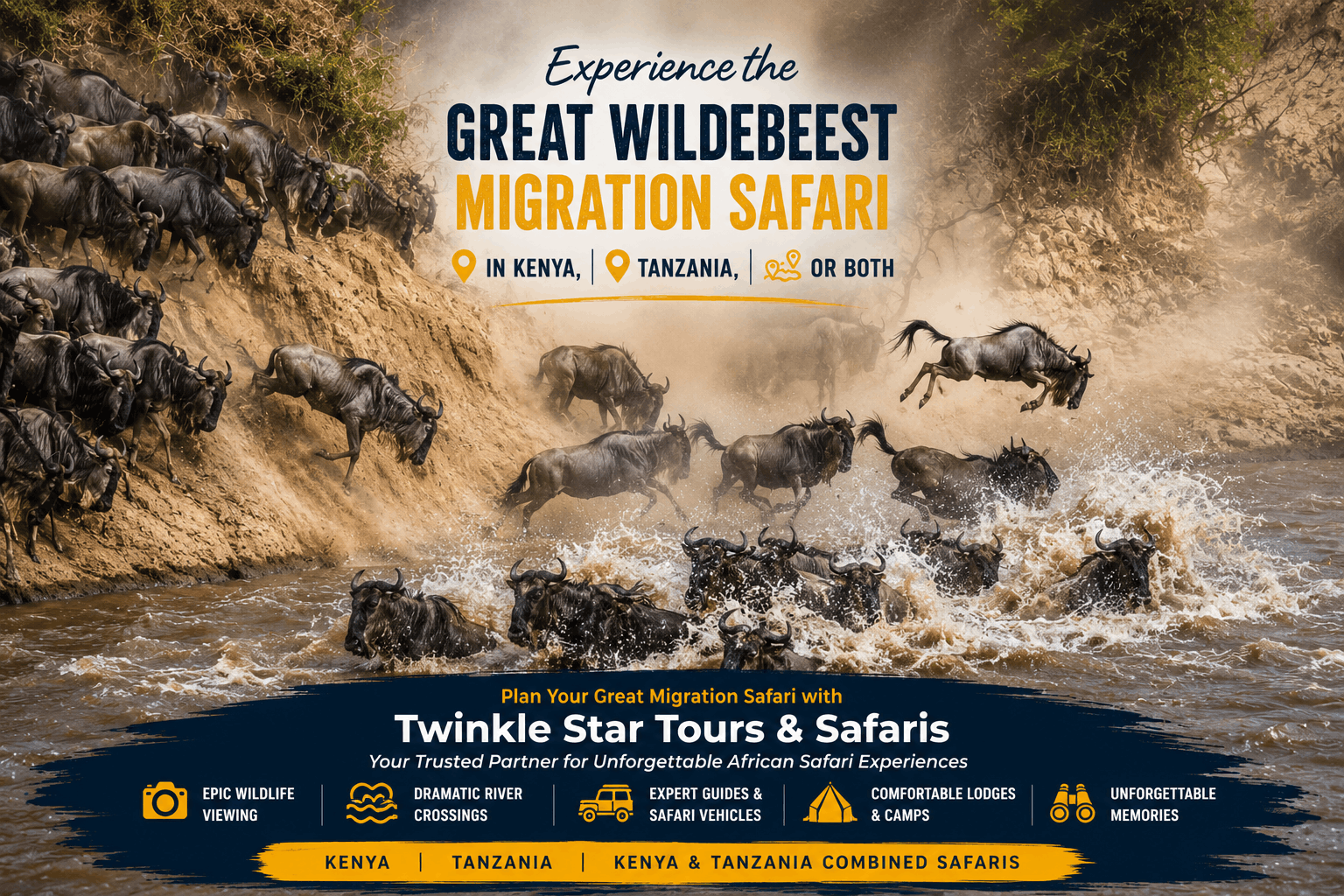
Ready to experience the Great Wildebeest Migration?
Twinkle Star Tours & Safaris can help you plan an unforgettable Kenya or Tanzania safari tailored to your preferred travel dates, budget and wildlife interests.
Whether you want to witness the Mara River crossings in Kenya, experience the wildebeest calving season in the Serengeti, explore the Masai Mara, or combine the two iconic destinations on a Kenya and Tanzania safari, our team can help you create the right itinerary for your journey.
We can assist with:
Start planning your Great Migration adventure with Twinkle Star Tours & Safaris and experience one of the world’s greatest wildlife spectacles.
Contact us today to plan your unforgettable African safari.
A tailormade tour with Twinkle Star Tours will put you in control of what you would like to do and experience in your safari to Africa. The above is just an indication of what an itinerary can be like.
Choose from an extensive list of safari accommodations to suit your needs, budget and style. Add on additional safari activities or choose from our range of day tours to make the perfect bespoke safari package tour.
Twinkle Star Tours take pride in making sure that your safari package is completely customisable. Receive a full breakdown itinerary via email containing everything in once place making your African journey smooth and easy.
To discuss any of our safari tours and packages or discuss any amendments you would like to make speak to our expert team who will be able to help make your safari dream a reality.
The answer depends on what you want to experience.
Best Time for Mara River Crossings:
August and September are generally among the most popular months.
However, crossings can occur from around July through October, depending on conditions.
There is no guarantee of a crossing on a particular date.
Best Time for Calving Season:
February and March are excellent months for witnessing newborn wildebeest and predator activity in the southern Serengeti.
Best Time for Large Herds in the Masai Mara:
July through October is generally the prime period.
August and September are particularly popular.
Best Time for Fewer Crowds:
Consider the shoulder periods around:
June
October
November
These periods can offer excellent wildlife experiences with potentially fewer visitors.
Best Overall Month for a Masai Mara Migration Safari:
If your main objective is to experience the northern migration and possibly witness a Mara River crossing, September is an excellent month to consider.
However, the best month ultimately depends on rainfall patterns, accommodation availability and your specific safari objectives.
This is one of the most common questions asked by safari travellers.
The answer depends on the experience you want.
Why Choose the Masai Mara?
The Masai Mara is particularly attractive for travellers who want:
The northern migration
Possible Mara River crossings
Excellent predator sightings
A compact wildlife experience
A Kenya safari
The Masai Mara is especially popular between July and October.
Why Choose the Serengeti?
The Serengeti is ideal for travellers who want:
The calving season
Huge open landscapes
A longer migration experience
The southern and central phases of the migration
A Tanzania safari
The Serengeti is also home to excellent resident wildlife throughout the year.
Why Combine Kenya and Tanzania?
For travellers who want to experience the migration as a complete ecosystem-wide journey, combining the Masai Mara and Serengeti can be an excellent choice.
A combined safari can allow you to experience:
Southern Serengeti → Central Serengeti → Northern Serengeti → Masai Mara
The ideal route depends on the month of travel.
No.
This is perhaps the most important thing to understand before booking a Great Migration safari.
No reputable safari company can guarantee a river crossing on a specific date.
The animals do not follow a timetable.
Their behaviour depends on:
Sometimes thousands of wildebeest may gather at a river and refuse to cross.
At other times, a crossing can happen suddenly.
The best way to increase your chances is to spend several nights in the migration area and work with experienced guides who monitor the herds.
Your ideal safari length depends on your goals.
For a Short Masai Mara Migration Safari:
Allow at least 3 to 4 nights in the reserve or surrounding conservancies.
For a Dedicated Mara River Crossing Safari:
Consider 4 to 5 nights or more.
The additional nights increase your chances of being in the right place when the herds move.
For a Kenya and Tanzania Migration Safari:
Consider 7 to 12 nights.
This allows you to experience more than one part of the ecosystem.
For a Comprehensive Great Migration Journe:
A 10- to 14-night itinerary or longer can provide a more complete experience, particularly if you want to combine the migration with other parks and destinations.
Peak migration months can be extremely popular.
If you are planning to travel during July, August or September, it is advisable to begin planning well in advance.
Early booking gives you a better choice of:
This is particularly important for travellers seeking accommodation in prime migration locations.
For travellers planning a 2027 Great Migration safari, early planning is especially recommended for the busiest months.
Both options have advantages.
Road Safari:
A road safari allows you to experience the landscapes between destinations.
It is ideal for travellers who enjoy:
Scenic drives
Flexibility
Overland journeys
Exploring multiple destinations
Flying Safari:
Flying can save significant travel time.
It is particularly useful when combining:
Nairobi
Masai Mara
Northern Serengeti
Central Serengeti
Zanzibar
For travellers with limited time, flying can maximize the number of hours spent on safari.
The migration takes place across an enormous ecosystem.
Therefore, simply being in the Masai Mara or Serengeti does not guarantee that you will be close to the herds.
Your accommodation’s location matters.
A camp located near the current migration route may provide a much better experience than one that requires long daily drives.
This is one reason why working with an experienced safari operator can be valuable.
Your itinerary should be designed around the expected movement of the herds, not simply around famous park names.
Absolutely.
One of the biggest misconceptions about the Great Migration is that it only exists between July and September.
The migration is a year-round phenomenon.
Different months offer different experiences.
January to March
Best for calving and predators.
April to June
Best for experiencing the northward movement.
July to October
Best for the northern migration and possible Mara River crossings.
November to December
Best for experiencing the return south.
There is therefore no single “best” month for everyone.
The best time depends on your interests.
Choose Kenya if you want:
Choose Tanzania if you want:
Choose Both if you want:
The Great Wildebeest Migration occurs throughout the year.
The herds generally gather in the southern Serengeti for calving around January to March, move north through the Serengeti between April and June, reach the northern Serengeti and Masai Mara around July to October, and begin returning south around November and December.
The best time depends on what you want to see.
Visit the southern Serengeti around February for calving season, or travel to the Masai Mara and northern Serengeti between July and October for the northern migration and possible Mara River crossings.
August and September are among the most popular months.
However, crossings may occur between July and October depending on weather and herd movements.
No specific crossing date can be guaranteed.
The herds are generally concentrated in the southern Serengeti and Ndutu area.
The calving season begins around this period.
The southern Serengeti and Ndutu region are generally the main areas for the calving season.
This is an excellent time for seeing newborn wildebeest and predators.
The herds are generally moving through the western and northern parts of the Serengeti.
Some groups may be approaching the Mara River ecosystem.
Large herds are generally distributed across the northern Serengeti and Masai Mara ecosystem.
This is one of the best periods for experiencing the northern migration.
Many herds may remain in the Masai Mara and northern Serengeti.
Possible Mara River crossings can continue.
The herds may still be in the Masai Mara and northern Serengeti, although some groups may begin moving south.
No.
The migration takes place across the wider Serengeti–Mara ecosystem, which includes northern Tanzania and southern Kenya.
The Serengeti hosts the migration for much of the year, while the Masai Mara becomes particularly important during the northern phase.
Neither destination is universally better.
The Masai Mara is particularly famous for the northern migration and possible Mara River crossings.
The Serengeti offers a much broader migration experience and is especially important during the calving season.
Yes.
February is one of the best months to experience the migration in the southern Serengeti.
It is particularly famous for calving and predator activity.
Yes, but the main migrating herds are generally concentrated farther south during much of the year.
The Masai Mara remains an exceptional year-round safari destination because of its resident wildlife.
The migration is commonly estimated to involve around 1.5 million wildebeest, accompanied by large numbers of zebra and gazelles.
Population estimates can vary.
The animals move primarily in response to rainfall, fresh grazing and water availability.
They follow the seasonal availability of nutritious grass across the ecosystem.
No.
The migration is made up of many herds and smaller groups.
Some animals cross the Mara River while others may remain in Tanzania or cross at different locations and times.
The Great Migration is the entire annual movement of wildlife through the Serengeti–Mara ecosystem.
The Mara River crossing is one spectacular event within this much larger natural cycle.
Yes.
September is often an excellent month for experiencing the northern migration.
The herds may still be concentrated in the Masai Mara and northern Serengeti, and river crossings may continue.
Essential items include:
A good pair of binoculars can significantly enhance the safari experience.
WhatsApp us